Tuesday, February 23, 2016

5.4.5. DÉTOUR: UNE ÉVOLUTION COMPARABLE AU DAHOMEY

LA TRANSFORMATION DES MONARCHIES FRANÇAISE ET DAHOMIENNE FACE À LA CROISSANCE SE RESSEMBLENT

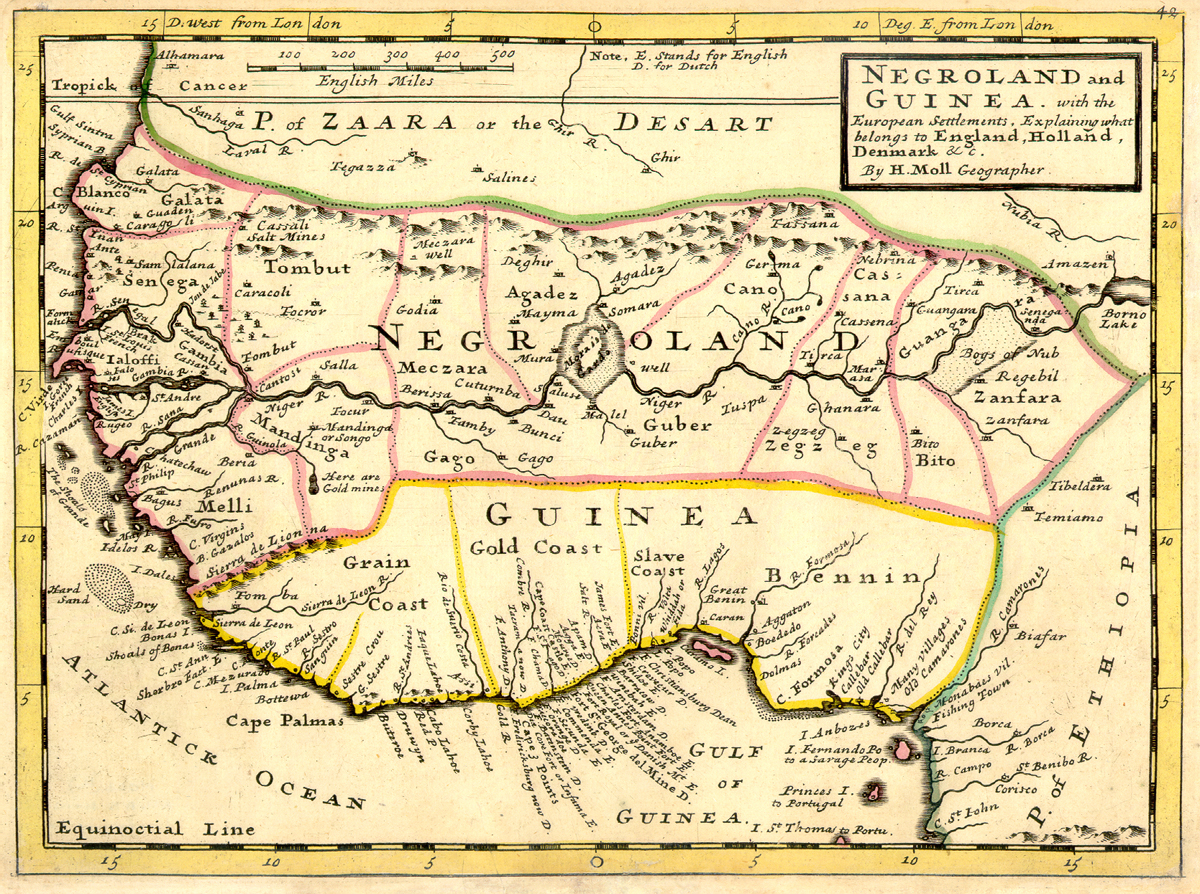
Au Dahomey, la conquête de royaumes côtiers permet le contact directe avec les marchands blancs, donc une croissance économique. 

La côte d'Afrique de l'Ouest en 1736zoom


Royaume du Dahomey en 1793 / zoom


Le sacre du roi de Whydah souligne son rapport avec le  python, symbole de sagesse, fertilité et d'harmonie cosmique — 
une expression universelle. 

Couronnement du roi de Juida  [Ouidah, sur la côte de Bénin] en avril 1723 par Jacob van der Schley / zoom 


https://commons.wikimedia.org/wiki/File:Le_Tour_du_monde-07-p065.jpg
https://commons.wikimedia.org/wiki/File:FORBES(1851)_p2.345_THE_HUMAN_SACRIFICES_OF_THE_EK-CNEE-NOO-AH-TOH.jpg
https://www.africanhistoryextra.com/p/the-kingdom-of-dahomey-and-the-atlantic?hide_intro_popup=true
*     *

Les vainqueurs remplacent le serpent par les ancêtres. Plus proches des hommes donc plus puissants, ils correspondent mieux au régime qui maîtrise l'économie due au commerce directe avec les blancs.

Dix captifs sont sacrifiés à la fin des couronnements, pour envoyer des serviteurs à ces ancêtres. 

Zoom (permission pour utiliser à demander)  

La procession pour montrer la richesse du roi, en 1851.

Ce drame se passe à Whydah, pas à Abomey, puisqu'on voit des navires en arrière-plan: le régime souligne sa domination, mais les dix sacrifiés, qu'on voit clairement dans la deuxième image, n'a rien à voir avec le nombre exécutés un peu plus tard.   


*     *
Le roi sacrifie un surplus de trois cent captifs pour qu'ils ne tombent pas dans les mains de producteurs de huile de palme indépendants. Le phénomène est du à une situation exceptionnelle, mais indique la menace que représente cette force et la violence du roi pour la maîtriser.

Sacrifice humain au Dahomey en 1863, "Le Tour du Monde"


Under older economic models, the Dahomey kings exercised tightly regulated control over the acquisition and sale of war captives. Palm oil fundamentally disrupted this dynamic: [1]

Erosion of the Royal Monopoly
  • Production Decentralization: Oil palms grew naturally and could be cultivated on small-scale plots by ordinary families and independent farmers. [1, 2]
  • Control Limitations: Because the resource was geographically scattered, the monarchy could not enforce a strict royal monopoly on production or distribution. [1]
  • Wealth Accumulation: Wealthy independent brokers—such as the prominent indigenous merchants Adjovi, Gnahoui, and Houenou—built private commercial empires. Their newfound wealth directly rivaled the financial supremacy of the throne. [1, 2, 3]
Mais des producteurs indépendants d'huile de palme menacent le contrôle royale. Les rois répondent par des sacrifices d'esclaves.  qui renforce leur pouvoir politique, mais les affaiblit économiquement et contribuent à leur conquête par les Français. 

Revenons au Roi-Soleil.

Fin de cette section 

*     *     *

Suite,


Voluntary Transition: Many inner-circle court members entered these sacrifices willingly, fully believing they were transitioning to Kutome to retain their high-ranking statuses alongside their master in the afterlife.

Divine Lineage: The royal family claimed direct lineage from the Vodun (spirits), who were themselves the children of Mawu-Lisa


Rather than selling captured prisoners of war to European merchants, Ghezo kept them within Dahomey to establish state-run agricultural operations. [1]
  • Massive Deforestation and Planting: Enslaved laborers cleared dense tropical forests across southern Dahomey to plant millions of new oil palm trees (Elaeis guineensis). [1, 2]
Undercutting Competitors: Small-scale, independent local farmers relied on family labor and wild-growing palms. By using massive gangs of unpaid, enslaved captives, Ghezo generated an enormous economy of scale that independent producers could not match.

eplenishing the Labor Pool: To keep the existing 650,000 hectares of royal oil palm farms operational, Glele launched brutal, sweeping military campaigns against neighboring Yoruba states, including the destruction of Içaga, Ibara, and Ketou

AI Mode conversation: did indedpendent traders and palm oil producers challenge Dahomey kings?

You said: did independent traders and palm oil producers challenge Dahomey kings?

did independent traders and palm oil producers challenge Dahomey kings?
Yes, independent traders and palm oil producers significantly challenged the Dahomey kings during the 19th-century transition from the transatlantic slave trade to "legitimate commerce". This shift decentralized economic power, creating structural friction that weakened the monarchy. [1, 2]
The economic transition triggered internal political conflict, fiscal policy disputes, and factional polarization. [1]
The Rise of the "Fly Faction"
The 19th-century commercial shift gave rise to deep political polarization within the Dahomean state council: [1]
  • The Elephant Faction: Composed of the king, royal elites, and Afro-Brazilian slave merchants (such as the de Souza family), this group fought to preserve the state-controlled slave trade. [1, 2]
  • The Fly Faction: A political coalition of independent palm oil producers, indigenous merchants, and localized chieftains. They challenged royal policy by demanding accommodation with British abolitionists to expand free-market agricultural exports. [1, 2, 3]

Fiscal and Policy Conflicts
The rise of a private commercial sector sparked direct pushback against the royal government: [, 2]
  • Taxation Revolts: Local merchants routinely protested the monarchy's aggressive and expropriatory fiscal taxes, which aimed to reclaim private profits for the royal treasury. [, 2]
  • Foreign Policy Defiance: Independent traders actively resisted royal military campaigns against neighboring states like Abeokuta. They prioritized peaceful, continuous regional trade over state-sponsored expansion. [1, 3]
This internal fracturing deeply undermined the kingdom's political unity, ultimately making Dahomey vulnerable to French colonial expansion at the end of the century. [, 2]
If you would like to explore this topic further, I can provide more details on:
  • The role of the Afro-Brazilian commercial elite in Whydah
  • How King Ghezo tried to compromise by utilizing slave labor on royal palm plantations
  • The differences between Dahomey's palm oil economy and the Niger Delta's "Oil Rivers" system [1, 2, 3, 4, 5, 6]
AI responses may include mistakes. Learn more
  • the supply of slaves for the Atlantic trade in Dahomey c. 1715–1850
    From the mid-eighteenth century, however, Dahomey did seek to operate as a ' middleman' in the supply of slaves from the interior,
    Cambridge University Press & Assessment
  • Royal Monopoly and Private Enterprise in the Atlantic Trade
    Core share and HTML view are not available for this content. However, as you have access to this content, a full PDF is available ...
    Cambridge University Press & Assessment
  • History of the Kingdom of Dahomey - Wikipedia
    The Elephant, connected with Ghezo, high-profile political leaders, and the creole slave traders like the family of De Sousa, push...
    Wikipedia
Show all
How King Ghezo tried to compromise by utilizing slave labor on royal palm plantations
King Ghezo of Dahomey (who ruled from 1818 to 1858) engineered a calculated economic compromise by redirecting slave labor away from export and into large-scale royal palm plantations. Faced with an aggressive British naval blockade and a collapsing transatlantic slave trade market, Ghezo did not abolish slavery. Instead, he industrialized it domestically to preserve the wealth and centralized power of the monarchy. [1, 2, 3, 4, 5, 6]
This transitional strategy relied on heavy infrastructure investment, strict legal monopolies, and a specialized division of forced labor. [1]
1. Creation of Royal Agricultural Estates
Rather than selling captured prisoners of war to European merchants, Ghezo kept them within Dahomey to establish state-run agricultural operations. [1]
  • Massive Deforestation and Planting: Enslaved laborers cleared dense tropical forests across southern Dahomey to plant millions of new oil palm trees (Elaeis guineensis). [1, 2]
  • Centralized Geography: The king concentrated these sprawling royal plantations directly around the capital city of Abomey and key political hubs to keep them under tight military surveillance. [1, 2]
  • Resource Preservation: To protect the crown's heavy capital investments, Ghezo passed an absolute decree in 1856 that strictly forbade any citizen from cutting down a palm tree. [1]
2. The Specialized "Gbablito" Labor Class
The extraction and transport of palm oil was incredibly grueling work. Ghezo designed a highly structured system of labor specialization utilizing the state's slave pool: [1]
  • Processing Tasks: Enslaved men, women, and children performed the intense physical labor of harvesting heavy fruit bunches, boiling the pulp, and treading the mash in deep pits to extract the oil. [1, 3]
  • The Gbablito: Ghezo created a dedicated, elite class of muscular, enslaved men known as the gbablito. [1]
  • Logistical Transport: Because Dahomey lacked navigable rivers near the capital, the gbablito were forced to manually roll massive, heavy wooden drums (casks) of palm oil across rough dirt roads from Abomey all the way to the coast at Whydah for export. [1]
3. Bypassing Free-Market Challengers
Ghezo's reliance on plantation slavery was a direct political weapon against the independent traders (the "Fly Faction") who threatened his throne. [1, 2, 3]
  • Undercutting Competitors: Small-scale, independent local farmers relied on family labor and wild-growing palms. By using massive gangs of unpaid, enslaved captives, Ghezo generated an enormous economy of scale that independent producers could not match.
  • Exclusive European Alliances: The king leveraged his massive royal supply to bypass local middlemen entirely. In 1842, Ghezo signed a direct commercial monopoly treaty with French merchant Victor Régis. This guaranteed that the French bought oil directly from royal warehouses, starving independent local brokers of international business. [1, 3, 4, 5]
Through this internal pivot, Ghezo successfully proved to the Atlantic world that slave labor and "legitimate" agricultural commerce were entirely compatible. He temporarily kept the Dahomean treasury afloat while keeping the rising merchant class economically dependent on the crown. [1, 2]
If you want to look closer at the mechanics of this system, let me know if you would like to explore:
  • How the French merchant Victor Régis facilitated this royal monopoly
  • The specific ways King Glele (Ghezo's successor) altered or maintained these plantations
  • A comparison of how women vs. men were utilized as slaves on these estates [1, 2, 3]
AI responses may include mistakes. Learn more
  • The History of the Kingdom of Dahomey
    28 Nov 2019 — Internally, the pressure resulted in a number of changes. Ghezo rejected British requests for ending the slave trade, but at the s...
    Black History Month 2026
  • During the nineteenth century, the trans-Atlantic slave trade ...
    During the nineteenth century, the trans-Atlantic slave trade was made illegal and eventually suppressed, and superseded by altern...
    National Academic Digital Library of Ethiopia
  • Women and slavery in the Kingdom of Dahomey - Persée
    Slaves were used to work the royal plantations, the royal farms and the farms of upper-class free men 8. Slaves were employed to c...
    Persée
Show all
he specific ways King Glele (Ghezo's successor) altered or maintained these plantations
King Glele (who ruled from 1858 to 1889) maintained the structural framework of the royal palm plantations but profoundly altered their operational focus by shifting the kingdom back toward aggressive militarism and slave-raiding. While his father, King Ghezo, viewed the plantations as a permanent replacement for the human export market, Glele viewed agricultural commerce and the Atlantic slave trade as dual mechanisms that could be exploited simultaneously. [1, 2, 3, 4, 5]
Glele altered, expanded, and secured these massive agrarian networks through several key policy decisions:
1. Re-Ounces of Labor via Militarism
Glele was the candidate of a reactionary, highly militaristic faction that opposed Ghezo's gradual accommodation of Western abolitionist demands. [1, 2]
  • Replenishing the Labor Pool: To keep the existing 650,000 hectares of royal oil palm farms operational, Glele launched brutal, sweeping military campaigns against neighboring Yoruba states, including the destruction of Içaga, Ibara, and Ketou. [1, 2]
  • Dual-Purpose Captives: The influx of war captives was split. Instead of dedicating all captives to domestic plantation maintenance, Glele took advantage of a brief revival in Atlantic demand (driven by illegal Spanish markets in Cuba) to resume high-volume overseas slave exports while keeping the remainder as settled plantation laborers. [1, 2, 3, 4, 5]
2. Retaining and Bureaucratizing Royal Monopolies
Glele recognized that the oil plantations were vital for preventing independent domestic traders (the "Fly Faction") from taking over the economy. He maintained his father's central protections: [1, 2, 3]
  • The "Bush King" Institution: Glele maintained this unique double-monarchy construct where the official king handled foreign affairs, while a parallel "spiritual/bush king" persona symbolically owned and managed all agricultural production and internal trade. [1, 2]
  • Institutionalized Taxation: He formalized the kuzu tax, a mandatory agrarian levy that required subjects to pay a fixed percentage of their localized palm oil harvest directly to royal storehouses. This ensured that even independent production ultimately enriched the palace. [1, 2, 3, 4]
3. Shift to Coastal Treaties and Infrastructure Defense
As European industrial demand for palm oil expanded, the logistics of rolling casks from Abomey to Whydah became heavily targeted by geopolitical rivals. Glele adjusted the state's geographic strategy to defend his supply lines: [1, 2]
  • Ceding Coastal Ports: To guarantee a direct outlet for royal plantation products away from British interference, Glele signed treaties with the French in 1868 and 1878, ceding control of Cotonou and parts of Porto-Novo.
  • Porto-Novo Campaigns: He launched 13 distinct military expeditions against the Kingdom of Porto-Novo. This was a direct attempt to force neighboring networks to stop undercutting Dahomey’s state-inflated palm oil prices. [1, 2]
Ultimately, Glele’s strategy caused a sharp economic decline. Palm oil prices fluctuated globally, and his decision to divert thousands of plantation laborers to human sacrifice during the Annual Customs of Dahomey deeply disrupted the labor cycles required for agricultural efficiency. [1, 2, 3, 4]


*   *   

No comments:

Post a Comment